Chapters
It is the endless forms, stupid: a commentary on Svensson
Shuker, D. M., 9 Mar 2023, Evolutionary biology: contemporary and historical reflections upon core theory. Dickins, T. E. & Dickins, B. J. A. (eds.). Cham: Springer Nature, p. 219-223 5 p. (Evolutionary biology: new perspectives on its development; vol. 6).
Research output: Chapter in Book/Report/Conference proceeding › Chapter
On genetics, ecology, and the role of philosophy in evolutionary biology: a reply to Distin
Shuker, D. M., 9 Mar 2023, Evolutionary biology: contemporary and historical reflections upon core theory. Dickins, T. E. & Dickens, B. J. A. (eds.). Cham: Springer Nature, p. 511-514 4 p. (Evolutionary biology: new perspectives on its development; vol. 6).
Research output: Chapter in Book/Report/Conference proceeding › Chapter
The curious incident of the wasp in the fig fruit: sex allocation and the extended evolutionary synthesis
Shuker, D. M., 9 Mar 2023, Evolutionary biology: contemporary and historical reflections upon core theory. Dickens, T. E. & Dickens, B. J. A. (eds.). Cham: Springer Nature, p. 473-504 32 p. (Evolutionary biology: new perspectives on its development; vol. 6).
Research output: Chapter in Book/Report/Conference proceeding › Chapter
Nasonia wasp behavior genetics
Buellesbach, J., Watt, R. & Shuker, D. M., 1 Jan 2019, Encyclopedia of Animal Behavior. Elsevier Inc., p. 282-291 10 p.
Research output: Chapter in Book/Report/Conference proceeding › Chapter
Sexual Selection Theory
Shuker, D. M., 2014, The Evolution of Insect Mating Systems. Shuker, D. & Simmons, L. (eds.). Oxford University Press, p. 20-41
Research output: Chapter in Book/Report/Conference proceeding › Chapter
The genetic basis of speciation in a grasshopper hybrid zone
Shuker, D. M., King, T. M., Bella, J. L. & Butlin, R. K., 20 Sept 2005, Insect Evolutionary Ecology: Proceedings of the Royal Entomological Society's 22nd Symposium. CABI Publishing, p. 423-450 28 p.
Research output: Chapter in Book/Report/Conference proceeding › Chapter
Articles
Environmental stress influences reproductive success in male spider mites
Noël, E., Lefebvre, M. J. M., Lefèvre, S., Shuker, D. M. & Duncan, A. B., 1 Apr 2026, In: Ecological Entomology. 51, 2, p. 414-423 10 p.
Research output: Contribution to journal › Article › peer-review
Male mating behaviour is shaped by previous experience of both conspecific and heterospecific females in the seed bug Lygaeus simulans
Balfour, V. L., Aumont, C., Corliss, M. K. & Shuker, D. M., Jan 2026, In: Ecology and Evolution. 16, 1, p. 1-13 13 p., e72883.
Research output: Contribution to journal › Article › peer-review
On the role of mating systems: freeing the study of sexual behaviour from bias
Gourevitch, E. H. Z., Green, T. & Shuker, D. M., 1 Jun 2026, In: Animal Behaviour. 236, p. 1-13 13 p., 123591.
Research output: Contribution to journal › Review article › peer-review
Testing for cryptic male mate choice in an insect with high mating failure
Balfour, V. L., Abbs, M. M. & Shuker, D. M., 27 Mar 2026, In: Behavioral Ecology and Sociobiology. 80, p. 1-15 15 p., 44.
Research output: Contribution to journal › Article › peer-review
Are studies of mating systems too inbred? A commentary on Clo et al. (2025)
Shuker, D. M. & Smith, E. B. W., 21 Jul 2025, In: Journal of Evolutionary Biology. 38, 6, p. 712-715 4 p.
Research output: Contribution to journal › Article › peer-review
Hamilton's rule predicts sibling cannibalism in a wild population of insects
Abbs, M. M., Kennedy, J. R., Drago Rosa, A. & Shuker, D. M., 12 May 2025, In: Animal Behaviour. 224, 123196.
Research output: Contribution to journal › Article › peer-review
On the biological basis of beauty
Mendelson, T. C., Renoult, J. P., Rosenthal, G. G. & Shuker, D. M., Aug 2025, In: Biological Reviews of the Cambridge Philosophical Society. 100, 4, p. 1578-1593 16 p.
Research output: Contribution to journal › Article › peer-review
Sexual selection in wild populations of seed bugs: the role of size in pre-copulatory mate choice by females and males
Fritsch, O. S. & Shuker, D., Nov 2025, In: Journal of Evolutionary Biology. 38, 11, p. 1519–1532 14 p.
Research output: Contribution to journal › Article › peer-review
Is mating failure caused by cryptic male choice in the seed bug Lygaeus simulans?
Balfour, V. L., Armand, M. & Shuker, D. M., Sept 2024, In: Ecology and Evolution. 14, 9, 11 p., e70341.
Research output: Contribution to journal › Article › peer-review
Post‐copulatory sexual selection in an insect with high levels of mating failure
Balfour, V., Armand, M. & Shuker, D., 16 Oct 2024, In: Ecology and Evolution. 14, 10, 12 p., e70407.
Research output: Contribution to journal › Article › peer-review
Reviews
Book review: Genotype-by environment interactions and sexual selection. Edited by John Hunt & David J. Hosken. Chichester: John Wiley & Sons (2014)
Shuker, D. M., 2015, In: Animal Behaviour. 107, p. 209-211
Research output: Contribution to journal › Book/Film/Article review › peer-review
Other publications
Facultative parthenogenesis
Smith, E. B. W. & Shuker, D. M., 24 Mar 2025, In: Current Biology. 35, 6, p. R204-R206 3 p.
Research output: Contribution to journal › Comment/debate › peer-review
Gametes best discriminate natural and sexual selection: a comment on Janicke 2024
Shuker, D. M. & Kvarnemo, C., 15 Oct 2025, In: Behavioral Ecology. 36, 5, p. 1-2 2 p., araf089.
Research output: Contribution to journal › Comment/debate
Measuring heritability: why bother?
Shuker, D. M. & Dickins, T. E., 13 Sept 2022, In: Behavioral and Brain Sciences. 45, e175.
Research output: Contribution to journal › Comment/debate › peer-review
The definition of sexual selection: a response to comments on Shuker and Kvarnemo
Shuker, D. M. & Kvarnemo, C., 9 Aug 2021, (E-pub ahead of print) In: Behavioral Ecology. Advance articles
Research output: Contribution to journal › Comment/debate › peer-review
Supergenes
Black, D. & Shuker, D. M., 8 Jul 2019, In: Current Biology. 29, 13, p. R615-R617
Research output: Contribution to journal › Short survey › peer-review
Cryptic male choice
Aumont, C. & Shuker, D. M., 22 Oct 2018, In: Current Biology. 28, 20, p. R1177-R1179
Research output: Contribution to journal › Short survey › peer-review
General intelligence does not help us understand cognitive evolution
Shuker, D. M., Barrett, L., Dickins, T. E., Scott-Phillips, T. C. & Barton, R. A., 1 Jan 2017, In: The Behavioral and brain sciences. 40, p. e218
Research output: Contribution to journal › Comment/debate › peer-review
Postcopulatory sexual selection when a female mates once
Dougherty, L. R., Simmons, L. W. & Shuker, D. M., Jun 2016, In: Animal Behaviour. 116, p. 13-16 4 p.
Research output: Contribution to journal › Comment/debate › peer-review
Mate choice and mating decisions: a response to comments on Dougherty & Shuker
Dougherty, L. R. & Shuker, D. M., Mar 2015, In: Behavioral Ecology. 26, 2, p. 326-327 3 p.
Research output: Contribution to journal › Editorial › peer-review
Mating failure
Greenway, E. V., Dougherty, L. R. & Shuker, D. M., 29 Jun 2015, In: Current Biology. 25, 13, p. R534-R536 3 p.
Research output: Contribution to journal › Editorial › peer-review


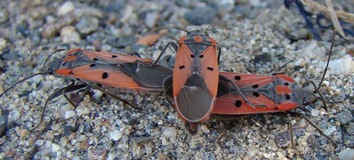
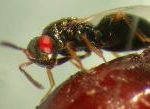 (pictured) and also sexual conflict and inter-species reproductive interference among five species of lygaeid seed bug. We mix behavioural experiments, ecological fieldwork, theoretical modelling, and genetic analysis to explore the evolutionary causes and consequences of variation in reproductive and sexual behaviour.