BL4225 – Advanced Microscopy and Image Analysis Seeing is Believing

BL4225 – Advanced Microscopy and Image Analysis Seeing is Believing
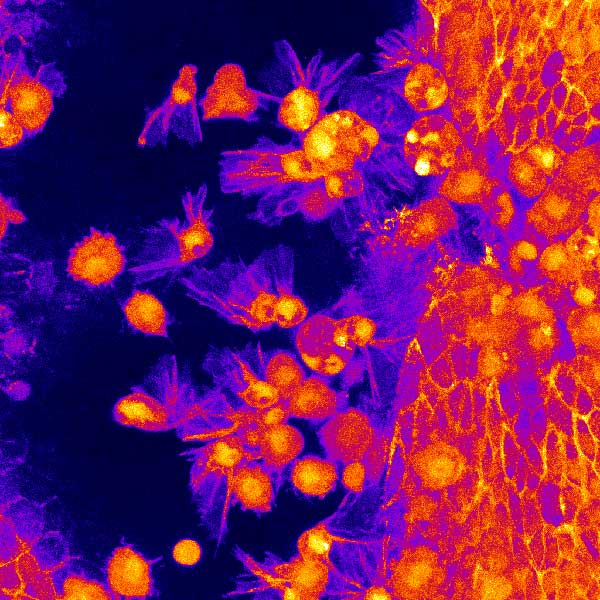
This module will introduce you to advanced imaging techniques, such as Confocal, Super-resolution, TIRF and Electron Microscopy and how these techniques have been utilised to address fundamental questions in Cell and Developmental Biology. You will get the opportunity to research techniques that are at the forefront of modern Biology and to develop skills in ImageJ analysis of imaging data, a skill that will be central to the advancement of bioscience in the coming years. Activities will be supplemented with research talks from academics at the cutting edge of their field.
Skills acquired in this module:
Related Programme(s):
Module Code:
BL4225
Semester:
1
Credits:
15
Module Organiser:
Dr Marcus Bischoff
Pre-requisite modules: BL3303 - Membranes and Cell Communication and BL3315 - Genes, Cells and Development
MMS
Timetable:
[events_list category="BL4225"]
Assessment:
1.5-hour Written Examination = 20%, Coursework = 80%MMS assessment details
The following related information applies to all Biology modules:
School of Biology Marking Criteria:
School handbook
Late submission of continuous assessment work:
All late submissions of coursework that do not require electronic submission should be made via the late submissions box in the Biology Study Space, St Andrews New Technology Centre Building (beside the Teaching Office)
Exam details:
School handbook
Exam timetable:
Timetable
Expected attendance:
School handbook
Good Academic Practice & Avoiding Academic Misconduct:
School handbook
University Student Handbook:
University student handbook
School and University Regulations:
School and University regulations in the School and University Undergraduate Handbook relating to absence reporting, penalties and rules for late submission of work, extensions for coursework, return of coursework, S-coding, good academic practice and Academic Alerts.
School handbook
University student handbook
Staff:
Learning Outcomes:
Students completing module BL4225 successfully should be able to:
- Acquire an understanding of different imaging techniques
- Understand their applications in Cell and Developmental Biology
- Be familiar with image processing and analysis techniques
- Find and critically evaluate information/literature
- Produce a concise figure legend
- Give a presentation, group discussion
- Use Excel and ImageJ, basic statistical analysis
- Produce a scientific figure
Policies:
(Information in this section applies to all Biology Modules)
- The procedures and regulations followed by the School of Biology are outlined in the University Handbook and in the School of Biology Undergraduate Handbook (https://biology.st-andrews.ac.uk/students/wp-content/uploads/sites/6/2022/05/Undergraduate-Handbook-2021-22.docx)
- All coursework associated with the module must be completed and submitted by its due date.
- Specific School regulations relating to absence reporting, penalties and rules for late submission of work, extensions for coursework, return of coursework, S-coding, Good Academic Practice and Academic Alert are stated in the School of Biology Undergraduate Handbook and students are required to carefully read these regulations.
- Students are also referred to the University Handbook, available at:http://www.st-andrews.ac.uk/studenthandbook/